
BÆREL - Advancing circularity in the Norwegian electronics industry

BÆREL is one of the projects funded through Grønn Plattform – a national initiative where The Research Council of Norway, Innovation Norway and SIVA collaborate to support the development and scaling of green solutions in Norwegian industry. The project runs from 2026 to 2028.
The project is led by SINTEF and brings together key stakeholders from both industry and research. Together, the partners will develop solutions that make electronic products and production value chains more sustainable and circular.
A growing need for circular value chains
Electronics manufacturing is critical to Norway’s competitiveness in strategic sectors such as defense, maritime, and offshore industries. At the same time, a significant share of the environmental footprint stems from raw material extraction and production.
Stricter regulatory requirements and increasingly vulnerable global supply chains are reinforcing the need for more robust and circular solutions. BÆREL addresses this by developing a holistic and data-driven value chain for electronics, from design and production to use, repair, and recycling.
From pilot to industrial transformation
The objective of the project is to develop and demonstrate circular and sustainable solutions that both increase value creation and resource efficiency, while strengthening the competitiveness of the Norwegian electronics industry.
This will, among other things, be realized through the establishment of the Nordic region’s first repair and calibration center for high-value electronics, as well as the development of a digital platform enabling seamless integration across the entire value chain – from design and production to reuse, repair, and recycling – including feedback loops that improve resource efficiency and decision-making.
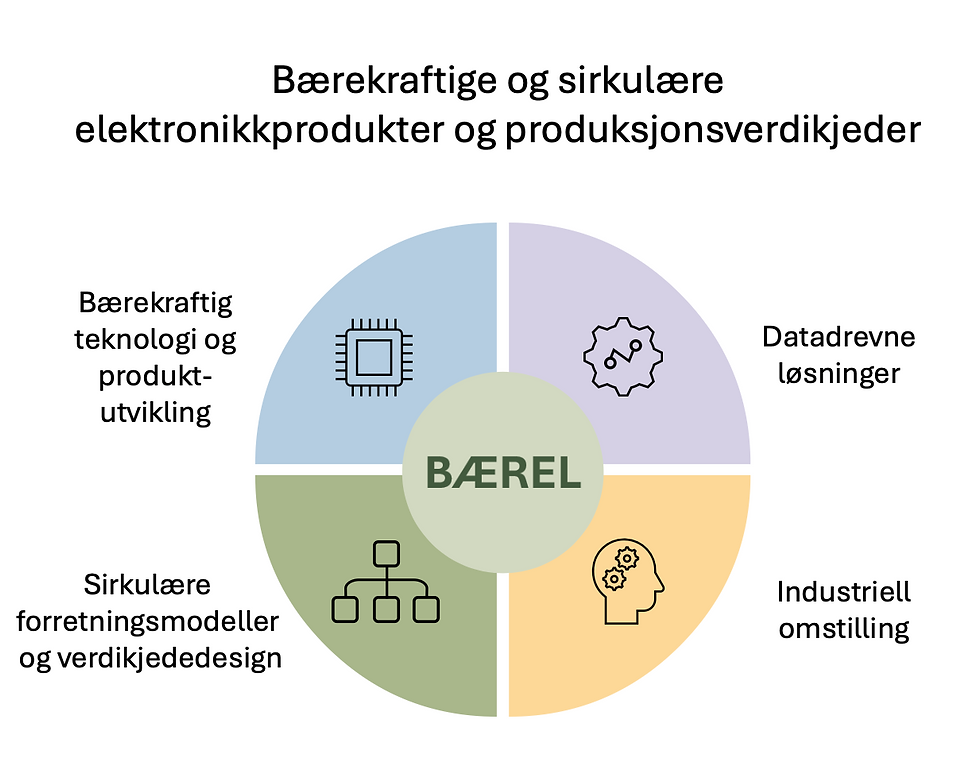
These solutions are expected to contribute to reduced emissions, lower energy use, and decreased material consumption, while extending product lifetimes and increasing material recovery. In addition, the project is expected to drive higher production efficiency and new revenue streams, more automated and safer processes, and the development of new competencies and skilled industrial roles.
The role of Thamsklyngen
Thamsklyngen plays an active role in the project, particularly in linking technology development with business development and collaboration across the value chain.
This includes the development of circular business models and value chains tailored to the needs of the pilot companies, as well as the development of roadmaps for scaling and standardizing circular solutions in the electronics industry. In addition, Thamsklyngen will contribute to the organization of open seminars and workshops for knowledge sharing.
Through this work, Thamsklyngen will help ensure that the solutions developed in the project are not only tested in pilots, but also adopted more broadly across industry.

Read more about the project here


Comments